
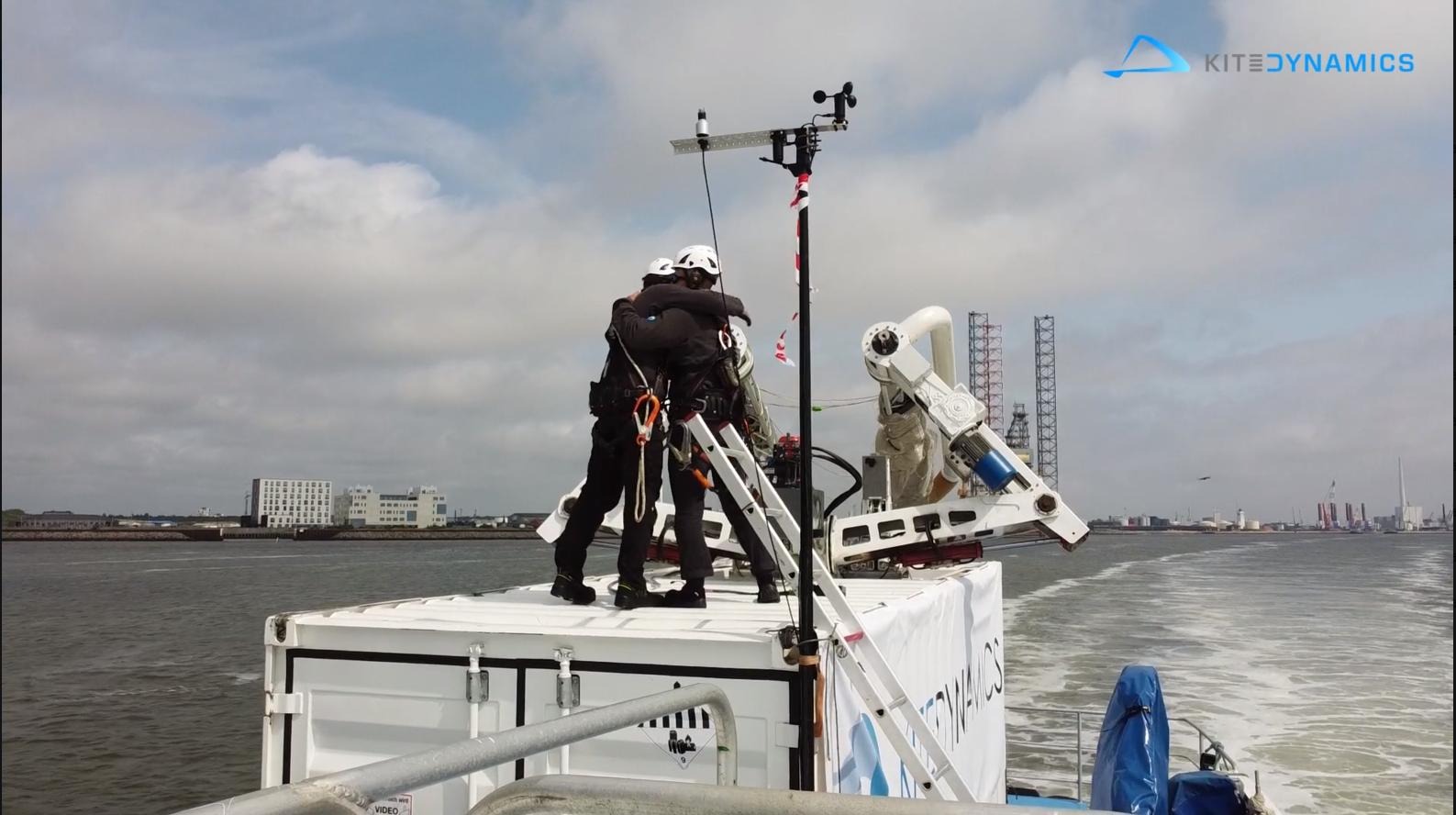

Proof on Sea – Water test in June 2025
Successful test flights to demonstrate kite control and kite propulsion at sea
In June 2025, Kite Dynamics AG achieved a key technological milestone: the successful water testing of the V1 system under real offshore conditions.
The aim was to comprehensively validate the control and propulsion technology on a ship in the open sea for the first time—under the influence of waves, ship movements, and variable wind conditions.
Objective of the water test
- Safe launch, flight, and landing of a 15 m² kite
- Proof of precise controllability on a moving platform
- Analysis of the influence of waves on flight stability and control
After more than 250 successful test flights on land, the next logical step followed: the transition to real offshore conditions—the so-called proof on sea.
Technical requirements & modifications
Extensive modifications were made to ensure maritime operational capability:
- Conversion of the P1 plant for offshore conditions
- Waterproof electronics and increased corrosion protection
- Mechanical modifications for quick assembly and disassembly
- Complete functional test on land
Test platform & location
The crew transfer vessel MHO 1, owned by the shipping company MHO-Co A/S, served as the test platform.
Technical data:
- Length: 28.5 m
- Width: 7.5 m
- Displacement: approx. 80 tons
- Home port: Esbjerg, Denmark
The test lasted two days in the North Sea.
Results: Controllability and stability confirmed
The test results:
- Hardly measurable influence of ship movement on kite control
- Stable automatic takeoff and landing processes
- Safe power flight even in rough seas
- Complete recording of all flight data
For the first time, it has been proven that kite control and propulsion technology works reliably and safely on a ship.
Performance data: Wind power in figures
- 15 m² high-performance kite (K1 class)
- Towing capacity of 1–1.5 tons
- Acceleration of an 80-ton ship
- From 1 to 4–4.3 knots
- In about 50–60 seconds
- Test wind speed: approx. 20 knots
Even a relatively small kite can deliver significant propulsion power—a decisive factor for scaling.
The technical heart: P1 & K1 Power-Train
The tested system consisted of:
- 15 m² high-load kite
- Four control lines for dynamic wind loads
- K1 Power-Train with integrated generator
The integration was carried out entirely within the ship's operational activities.
Background to the development of P1
Cape Town / South Africa (from 2020)
- Early testing phase
- Hardware and software development
- Optimization of flight control
Germany (from 2024)
- Preparation for sea trials in East Frisia
- Current: Flight tests near Stuttgart
The P1 system is currently operated with 15 m² and 60 m² high-performance kites. Line lengths of up to 350 m are technically possible.
Classification & Outlook
The water test confirms the technical feasibility of wind-based ship propulsion systems at sea and provides reliable data for the next stage of development.
There is great, as yet untapped wind potential in the ocean areas of the trade wind regions. The concept of energy ships addresses this gap: mobile production units for green energy sources – independent of space restrictions.
The key is the Kite Charge product—a combination of propulsion and power generation using high-altitude wind technology.
The successful proof-at-sea tests demonstrated that the technology meets the high technical requirements.
The next step: scaling, system integration, and industrial implementation.





